
Sliding Gates vs Swing Gates: Which Works Best for Industrial Access?
Compare sliding gates vs swing gates for industrial access, including space, traffic, terrain, security, maintenance, and site requirements.
Introduction
An industrial gate is more than an opening in a perimeter fence. It can affect how vehicles enter and leave a site, how efficiently deliveries move through a facility, how much usable space remains around an entrance, and how well the access point integrates with the rest of the security fencing.
Two of the most common configurations to consider are sliding and swing gates. Although both can provide controlled access, they operate very differently. A sliding gate moves laterally along the fence line, while a swing gate opens through an arc similar to a large door. That fundamental difference influences almost every other part of the decision.
When comparing Sliding Gates vs Swing Gates, industrial buyers should therefore look beyond the gate opening width. Available space, vehicle movements, ground conditions, traffic frequency, gate weight, support structure, operating method, maintenance access, security requirements, and surrounding infrastructure all deserve consideration.
There is no gate type that is automatically best for every industrial property. The goal is to choose a configuration that suits the actual access point and can be incorporated correctly into the site's wider fencing system.
TLDR Quick Guide
Sliding gates move horizontally along the fence line, while swing gates rotate inward or outward through an opening arc.
Sliding gates can be advantageous where the site cannot dedicate substantial clear space in front of or behind the gate.
A sliding gate still requires sufficient lateral space beside the opening to accommodate the gate leaf and operating system.
Swing gates need a clear opening arc that remains free of vehicles, stored materials, buildings, landscaping, and other obstructions.
Single and double swing configurations can suit different opening widths and site layouts.
Industrial traffic patterns should be considered before choosing either design.
Wide vehicle access can influence gate configuration, structural requirements, and hardware selection.
Ground slope and surface conditions can affect the practicality of both sliding and swing gates.
What Is the Main Difference Between Sliding and Swing Gates?
Sliding Gates Move Parallel to the Fence
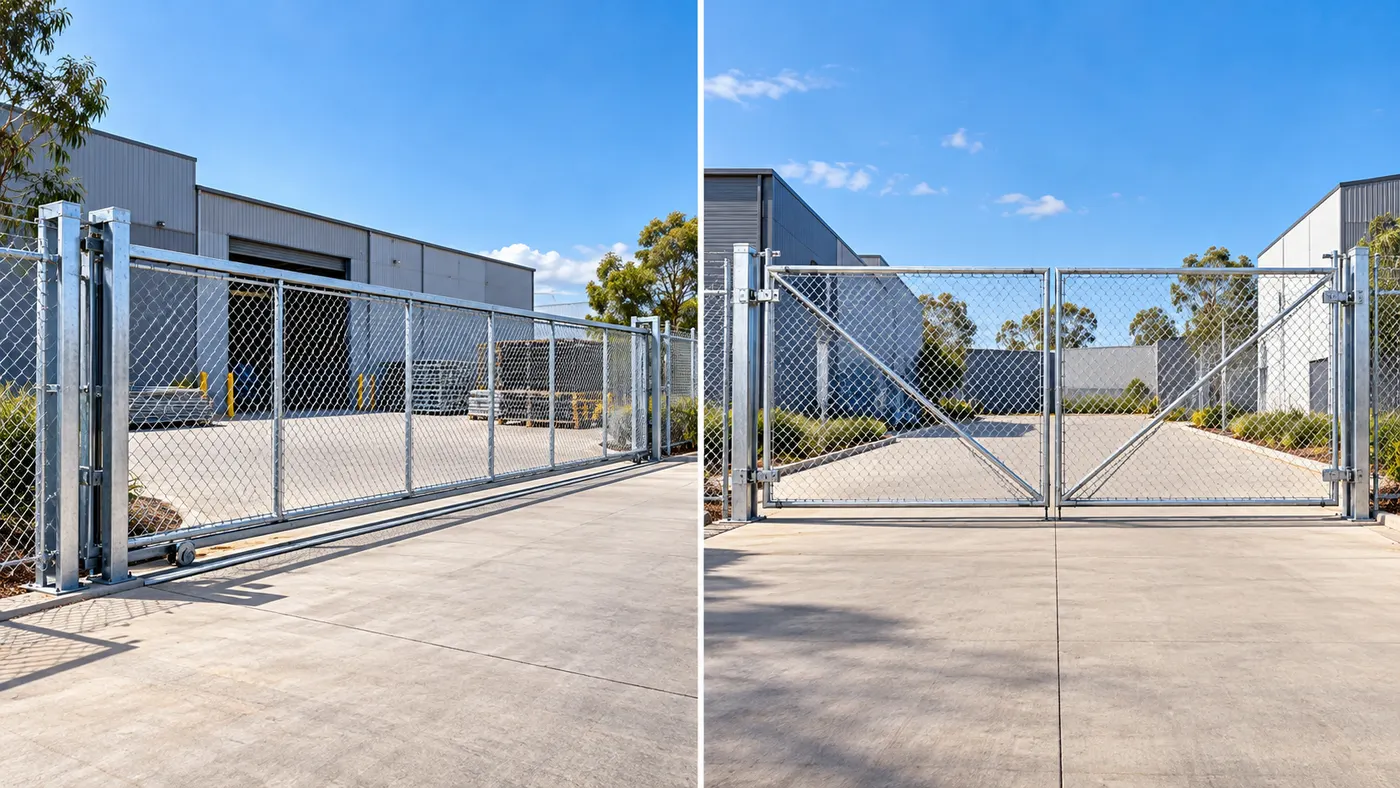
A sliding gate opens by travelling horizontally beside the fence rather than moving through the vehicle approach area. Depending on the system, the gate may run on a ground track or use a cantilever-style arrangement supported above the driveway surface.
This lateral movement can make sliding gates useful for industrial entrances where the area immediately inside the gate needs to remain available for vehicle movement.
However, a sliding gate does not eliminate space requirements. Instead of requiring an opening arc, it needs adequate room along the fence line for the gate leaf to travel when opened.
That distinction should be checked early in the design process.
Swing Gates Open Through an Arc
Swing gates rotate around hinges mounted to gate posts.
A single swing gate uses one gate leaf, while a double configuration divides the opening between two leaves. Industrial buyers comparing these arrangements can also consider howsingle and double chainwire gates differ when planning the opening.
The major spatial consideration is the swing arc. The gate needs an unobstructed area through which it can move without conflicting with vehicles, buildings, stored materials, fencing, pedestrian routes, or other site features.
Sliding Gates vs Swing Gates: Which Requires More Space?
Sliding Gates Need Side Clearance
A common misconception is that sliding gates are automatically the space-saving choice.
They can save space in the vehicle approach and departure areas, but they require lateral room beside the opening.
For example, a wide industrial opening may require a substantial section of clear fence line to accommodate the open gate. Cantilever systems can require additional structural length beyond the clear opening because part of the gate acts as a counterbalance.
The available side space should therefore be measured rather than assumed.
Swing Gates Need Fore-and-Aft Clearance
Swing gates use a different portion of the site.
The area through which each leaf travels needs to remain clear whenever the gate operates. A wide single leaf can create a particularly large arc, while a double swing arrangement can reduce the length of each individual leaf.
This can work well on industrial properties with generous setbacks and low risk of vehicles obstructing the operating area.
It can be less convenient where trucks queue close to the gate or where every metre of the internal yard needs to remain usable.
How Does Vehicle Traffic Affect Gate Selection?
Industrial Entrances Need to Accommodate Real Vehicle Movements
An access point that works for passenger vehicles may behave very differently when used by semi-trailers, delivery trucks, forklifts, service vehicles, or other commercial traffic.
Before choosing a gate, consider:
- Typical vehicle dimensions
- Maximum vehicle dimensions
- Turning movements
- Entry and exit direction
- Delivery frequency
- Peak traffic periods
- Queue length
- Required clear opening
- Driver visibility
- Nearby intersections
- Internal roads
- Loading and unloading areas
These factors can determine whether a sliding or swing configuration integrates more effectively with site operations.
Queuing Space Can Be Particularly Important
If vehicles frequently wait immediately inside or outside an entrance, a swing gate's operating arc needs careful attention.
A vehicle stopped too close to the gate can prevent it from opening or closing fully.
A sliding gate moves out of the opening laterally, which may reduce that particular conflict. However, its lateral travel area must remain clear and protected from other site activities.
Which Gate Is Better for Wide Industrial Openings?
Both Configurations Can Accommodate Large Openings
A wide entrance does not automatically require a sliding gate.
Sliding, single swing, and double swing systems can all be designed for different opening sizes. The appropriate option depends on the opening, gate construction, available space, posts, hardware, operating method, wind exposure, and engineering requirements.
The wider and heavier the gate becomes, the more important these structural considerations become.
Double Swing Gates Divide the Opening
One reason to consider a double swing configuration is that it divides a large opening between two gate leaves.
That can reduce the length and weight carried by each individual leaf compared with one large swing gate.
However, it also introduces two leaves that need to align, latch, and operate correctly. The complete arrangement therefore needs suitable posts, hinges, latches, drop bolts or other specified hardware.
How Do Site Slopes Affect Sliding and Swing Gates?
Swing Gates Need Suitable Operating Clearance
Ground slope can create problems for a conventional swing gate.
If the ground rises in the direction the gate needs to open, the bottom of the leaf may encounter the surface before completing its travel. Increasing clearance beneath the gate is not always an acceptable solution because security, appearance, and site requirements may limit how much clearance is appropriate.
A sloping entrance therefore requires careful measurement before a swing gate is specified.
Sliding Gates Have Their Own Ground Requirements
A sliding gate should not automatically be assumed to solve every sloping-site problem.
Tracked sliding gates depend on an appropriately installed travel path, while cantilever arrangements introduce different support and structural requirements.
Drainage, debris, pavement condition, level changes, kerbs, and vehicle crossings can all influence the practicality of the design.
For challenging sites, the actual levels should form part of the gate specification rather than being addressed after fabrication.
How Does the Driveway Surface Affect the Decision?
Ground Tracks Need a Suitable Travel Path
A tracked sliding gate typically moves using rollers and a track installed across or alongside the opening.
In industrial environments, the track area can be exposed to dirt, stones, mud, leaves, packaging debris, and other material. The surface may also experience repeated heavy-vehicle movements.
Those operating conditions should be considered when evaluating the system and its maintenance requirements.
Cantilever Gates Avoid a Track Across the Opening
Cantilever sliding gates are supported so the gate can move without relying on a ground track across the driveway opening.
This can be useful where maintaining a clear vehicle crossing is important.
The trade-off is that a cantilever gate requires appropriate structural support and additional gate length for its counterbalance section. Available side space, foundation requirements, gate weight, and support hardware therefore remain important.
What Components Matter Most for a Swing Gate?
Gate Posts Carry Significant Loads
Swing gate performance depends heavily on its support posts.
The posts need to withstand the gate's static weight as well as forces created while it opens, closes, stops, and is exposed to wind. A large gate leaf can place substantial leverage on its hinge post.
Post selection should therefore correspond to the gate design rather than being treated as an interchangeable fencing component.
Hinges Need to Match the Gate
Hinges are another critical component.
Different gate weights, post types, adjustment requirements, and operating conditions can call for different hinge arrangements. Supaguard's guide to choosingchainwire gate hinges provides additional context on factors contractors should consider.
Using suitable hardware helps ensure the gate can be correctly installed and adjusted for its intended application.
What Components Matter for a Sliding Gate?
The Support and Guidance System Is Fundamental
A sliding gate needs components that support its weight and control its movement.
Depending on the design, these can include:
- Rollers
- Tracks
- Guide rollers
- Guide posts
- Stops
- Latches
- Cantilever hardware
- Structural supports
- Gate frames
- Automation components when specified
- Each component needs to be compatible with the overall system.
- Gate Alignment Matters
- A sliding gate travels along a defined path.
Poor alignment, unsuitable support, damaged rollers, track obstruction, or movement in structural components can interfere with operation.
This is why the gate itself should not be specified independently of its supporting hardware and installation conditions.
How Do Sliding and Swing Gates Compare for Security?
Gate Type Alone Does Not Determine Security
It is tempting to label one gate style as more secure than another, but industrial perimeter security depends on the complete design.
Important factors can include:
- Gate height
- Infill type
- Frame construction
- Gaps around the gate
- Latching or locking arrangement
- Posts and supports
- Fence-to-gate transitions
- Anti-climb requirements
- Access-control equipment
- Vehicle and pedestrian separation
- Site-specific risk requirements
A strong gate can still leave a weak access point if adjacent components are poorly matched.
The Gate Should Integrate With the Perimeter
An industrial gate usually interrupts an otherwise continuous fence line.
The transition between fence panels or chainwire and the gate posts should therefore receive the same attention as the gate leaf.
When reviewingindustrial security gates, consider the gate as one component within a complete perimeter rather than an isolated product.
How Does Wind Exposure Affect Industrial Gates?
Larger Gate Leaves Can Experience Greater Wind Forces
A gate presents surface area to the wind.
The amount of wind loading depends on factors such as gate dimensions, infill, site exposure, local conditions, and whether the gate is relatively open or solid.
This can influence posts, foundations, hinges, rollers, guides, operators, and other components.
Open Mesh Does Not Eliminate Wind Considerations
Chainwire and other open fencing systems allow more airflow than a solid gate, but they are not completely unaffected by wind.
Large gate dimensions can still create meaningful loads.
For exposed industrial sites or unusually large gates, appropriate engineering and site-specific assessment may be required rather than relying on a generic gate configuration.
Which Gate Is Easier to Automate?
Both Can Be Automated
Sliding and swing gates can both form part of automated access systems when the gate and automation equipment are designed appropriately.
Possible access-control arrangements may involve:
- Keypads
- Remote controls
- Card or credential readers
- Intercoms
- Vehicle detection
- Timers
- Building or site access-control systems
The appropriate configuration depends on the site's operational and security requirements.
Automation Should Be Considered Early
A common planning mistake is treating automation as something that can simply be added after the gate has been designed.
Gate weight, dimensions, travel, operating frequency, power availability, safety devices, controls, foundations, and equipment mounting can all affect an automated system.
If automation is planned, it should be incorporated into the specification from the beginning.
How Does Traffic Frequency Influence the Choice?
High-Use Entrances Need to Be Designed Around Duty
A gate at a lightly used storage yard may operate only a few times each day.
A gate serving a logistics facility, depot, warehouse, industrial estate, or busy commercial property may cycle far more frequently.
That difference matters.
Components and automation equipment should be selected for the expected operating duty rather than simply the dimensions of the opening.
Opening Speed Can Affect Site Flow
Gate operation can also influence vehicle queues.
The time required to authenticate a driver, open the gate, clear the vehicle, and close the entrance can accumulate during busy periods.
Instead of comparing gate types only by their theoretical opening motion, evaluate the complete access sequence and expected traffic volume.
What Maintenance Do Sliding Gates Require?
Moving Components Need Routine Inspection
Sliding systems rely on a defined travel mechanism.
Depending on the design, maintenance may involve checking tracks, rollers, guides, stops, fasteners, structural supports, and automation components.
Tracked systems may also require the travel area to be kept clear of material that could interfere with movement.
Site Conditions Influence Maintenance
A clean paved warehouse entrance creates different operating conditions from a dusty industrial yard, coastal site, mining environment, or unsealed access road.
Debris, corrosion exposure, vehicle impact, and general site activity can influence inspection and maintenance needs.
Maintenance planning should therefore reflect the environment rather than following a one-size-fits-all assumption.
What Maintenance Do Swing Gates Require?
Hinges and Alignment Need Attention
Swing gates depend heavily on their hinge points.
Over time, wear, impact, movement, or changes in alignment can affect how the leaves meet, latch, or clear the ground.
Posts and foundations should also remain stable because movement at the support can affect the entire gate geometry.
Double Gates Have Additional Alignment Points
A double swing gate has two leaves that need to meet correctly.
Latches, stops, drop bolts, hinges, and other hardware should continue operating as intended.
Regular inspection can help identify changes before they develop into more significant access problems.
What About Pedestrian Access?
Vehicle and Pedestrian Movements Should Be Planned Together
Industrial entrances often need to accommodate employees, visitors, contractors, cyclists, and heavy vehicles.
Forcing pedestrians through a vehicle gate can create unnecessary interaction between people and moving vehicles.
Where appropriate, a separate pedestrian access point can help keep movement patterns more clearly defined.
Gate Movement Zones Should Remain Clear
The operating area of any gate should be considered when planning pedestrian routes.
This is particularly obvious with a swing gate because of its visible opening arc, but sliding gates also have moving components and travel areas that should not be treated as pedestrian waiting zones.
Access planning should consider the whole entrance rather than the vehicle opening alone.
How Do You Choose Between Manual and Automated Operation?
Manual Gates Can Suit Lower-Use Access Points
Manual operation may be practical for entrances that are used infrequently and where authorised personnel can safely open and secure the gate.
It can also reduce the amount of powered operating equipment involved.
However, requiring drivers to leave vehicles repeatedly may be inconvenient or unsuitable for some industrial operations.
Automation Can Support Controlled Traffic Flow
Automated gates can integrate more easily into managed vehicle access where traffic is frequent.
The decision should account for expected cycles, access-control requirements, power, safety systems, emergency operation, maintenance, and site procedures.
Automation is therefore a system decision rather than merely a convenience upgrade.
What Should You Measure Before Ordering an Industrial Gate?
Start With the Clear Opening
The required clear opening should reflect the vehicles that actually use the entrance.
Do not base the measurement only on the existing gap between two fence posts.
Consider vehicle width, turning angle, mirrors, trailers, swept paths, traffic direction, and any future operational changes that are already known.
Measure the Surrounding Space Too
For a sliding gate, measure the available lateral run along the fence.
For a swing gate, confirm the usable opening arc and ground levels.
Also document:
- Fence height
- Existing posts
- Ground material
- Slope
- Drainage
- Kerbs
- Nearby structures
- Utilities
- Vehicle routes
- Pedestrian routes
- Automation requirements
- Desired opening direction
- Security requirements
The more complete the site information, the easier it is to evaluate an appropriate configuration.
Which Gate Works Better for Industrial Access?
Choose Sliding Gates When the Layout Supports Lateral Travel
A sliding gate may be particularly worth considering when:
- The approach area needs to remain clear.
- Vehicles queue relatively close to the entrance.
- There is sufficient lateral fence-line space.
- A wide opening is required.
- The site layout suits tracked or cantilever operation.
- The design can accommodate the required supporting structure.
- These are considerations rather than universal rules.
- Choose Swing Gates When There Is Ample Operating Space
- A swing gate may be practical when:
- There is enough clear space for the gate arc.
- The site does not require vehicles to wait within that arc.
- Ground levels allow suitable movement.
- The opening suits a single or double leaf.
- Suitable posts and hinges can be installed.
- The desired access arrangement is compatible with swing operation.
- Again, site conditions determine whether those advantages apply.
How Should Industrial Buyers Make the Final Decision?
Compare the Entire Access System
The best way to compare Sliding Gates vs Swing Gates is not to begin with appearance or habit.
Start with the operational requirements of the entrance.
Ask:
What vehicles need access?
How wide must the clear opening be?
How frequently will the gate operate?
Where will vehicles queue?
Is there enough lateral space for a sliding gate?
Is there enough clear arc for a swing gate?
What are the ground levels?
What surface crosses the entrance?
Will the gate be manual or automated?
What security requirements apply?
What fencing system surrounds the gate?
What maintenance conditions can be expected?
Once those questions are answered, the choice becomes much more site-specific and defensible.
Specify the Gate as Part of the Fence
Posts, gate frames, mesh or panel infill, hinges, rollers, guides, latches, fittings, and adjacent fencing need to work together.
Supaguard's product-focused approach is particularly relevant here because industrial access points frequently require coordinated fencing and gate components rather than an isolated gate leaf.
Planning the system together can help contractors develop a more complete material specification before fabrication and installation begin.
Key Takeaways
Sliding Gates vs Swing Gates should be compared according to the actual industrial site rather than assuming one design is universally better.
Sliding gates move parallel to the fence and need sufficient lateral travel space.
Swing gates require a clear operating arc in front of or behind the entrance.
Vehicle dimensions, turning movements, queues, and traffic frequency should influence the decision.
Wide industrial entrances can potentially use sliding, single swing, or double swing configurations.
Double swing gates divide an opening between two leaves but introduce additional hardware and alignment considerations.
Ground slope can affect both sliding and swing gate designs.
Tracked sliding gates require an appropriate travel path, while cantilever gates have different structural and space requirements.
FAQs
1. Are sliding gates better than swing gates for industrial sites?
Sliding gates can be advantageous where the vehicle approach needs to remain clear and adequate lateral space exists beside the opening. Swing gates may be equally practical where there is sufficient room for the opening arc and the site layout supports single or double leaves. The better choice depends on traffic, opening width, ground conditions, security requirements, available space, and the intended operating system.
2. Do sliding gates need more space than swing gates?
Sliding gates require lateral space along the fence line so the gate can move clear of the entrance. Swing gates instead require clear space through the arc travelled by each gate leaf, so their space requirement extends into or away from the access area. Measuring both areas is essential because neither gate type is inherently space-free.
3. Can sliding and swing industrial gates both be automated?
Both gate configurations can potentially be automated when the gate, operator, controls, foundations, safety equipment, and power arrangements are designed as a compatible system. The appropriate equipment depends on factors such as gate size, weight, travel, operating frequency, and site requirements. Automation requirements should ideally be identified before the gate is fabricated rather than added as an afterthought.
4. Which gate is better for a wide truck entrance?
A sliding gate can work well for a wide truck entrance when sufficient lateral space and suitable support are available, while a double swing gate can divide a wide opening between two shorter leaves. Vehicle swept paths, queuing, ground levels, wind exposure, operating frequency, and structural requirements all need to be considered. The opening should ultimately be designed around the largest vehicles and actual traffic movements expected at the site.
5. What should be checked before ordering an industrial gate?
Confirm the required clear opening, fence height, available side space, swing clearance, ground levels, surface conditions, vehicle movements, traffic frequency, and security requirements. The specification should also address posts, hardware, gate infill, manual or automated operation, surrounding fencing, and any site-specific engineering requirements. Accurate measurements and complete project information help determine whether a sliding, single swing, or double swing configuration is appropriate.
Products and a project to match.
Security Panels
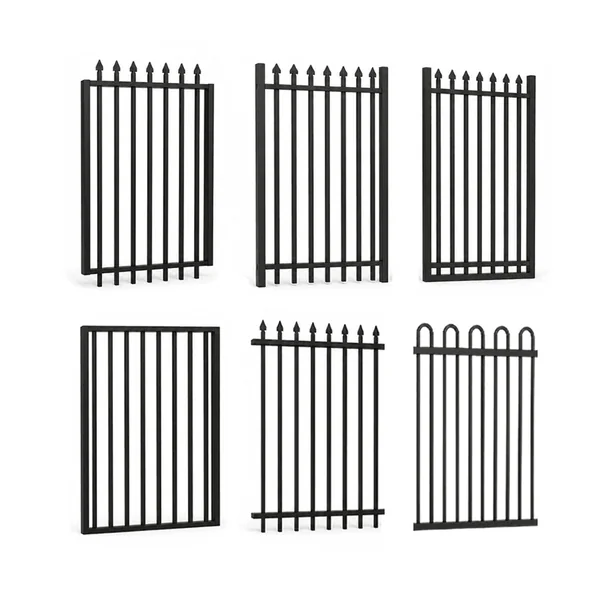
Security fence panels to AS1450: flat top and spear top panels and gates in galvanised steel, plus converter kits and picket extensions. Made in house.
Security Posts
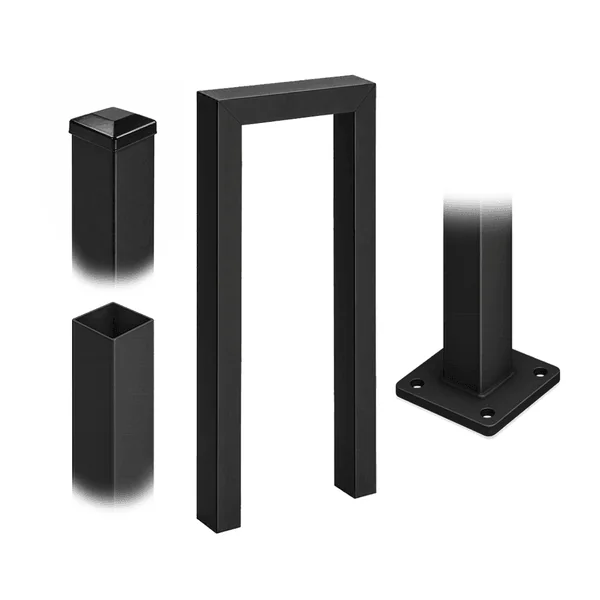
Heavy duty steel security posts, flange posts and tunnel posts for flat top and spear top fencing. Powder coated black or green. NSW and QLD supply.
Chainwire Gates
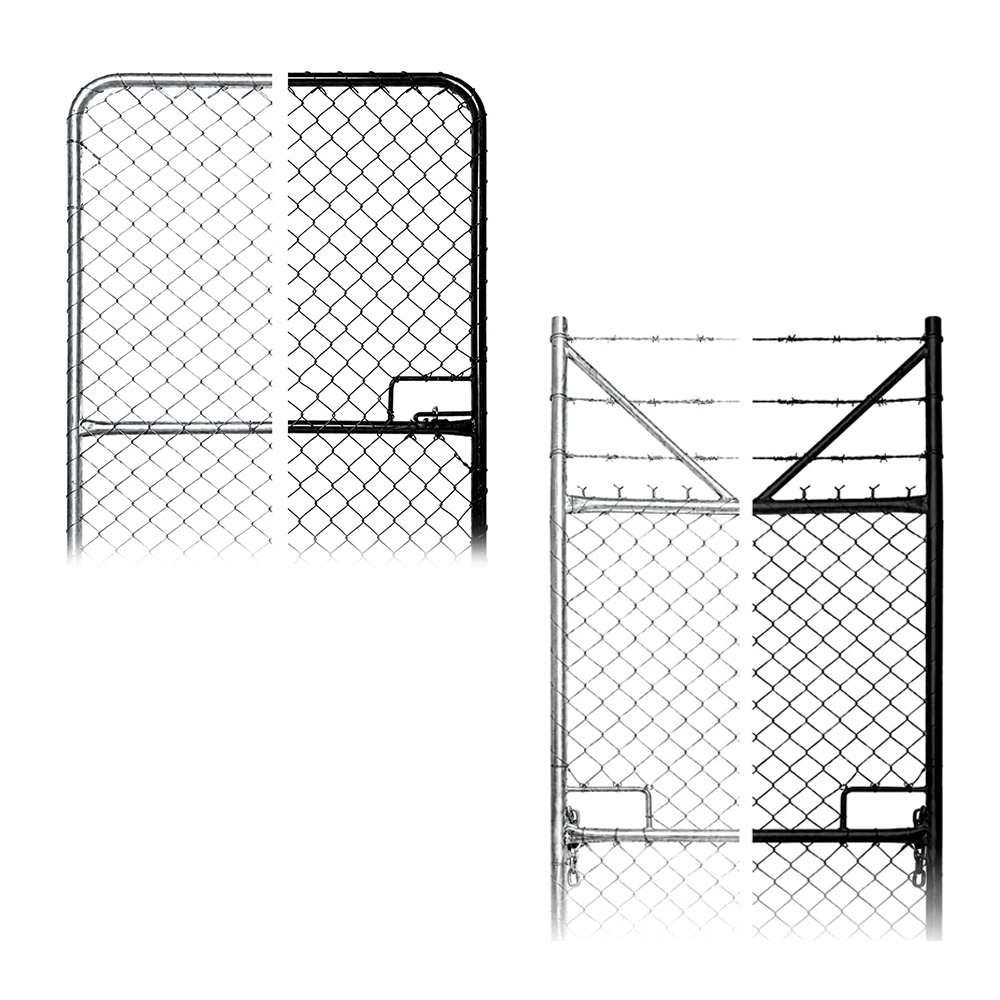
Single and double chainwire gates, with or without 3 barb, in galvanised or black. In stock or custom fabricated in house. Supplied from NSW and QLD.
 Industrial
Anti-climb boundary and sliding gates for a logistics yard
Australia
Warehouse and container yard boundaries built from anti-climb mesh and spear-top steel, with razor topping on the exposed runs and sliding gates on the vehicle entries.
More from the blog.
 Custom Security Gates
When Should Commercial Sites Order Custom Security Gates?
2 Nov 2026
Learn when custom security gates for commercial sites make sense for unusual openings, heavy traffic, access control and perimeter security.
 Depot Security
How Do You Choose Chainwire Fencing for Depot Security?
3 Oct 2026
Learn how to choose chainwire fencing for depot security, including mesh, height, gates, posts, fittings and access requirements.
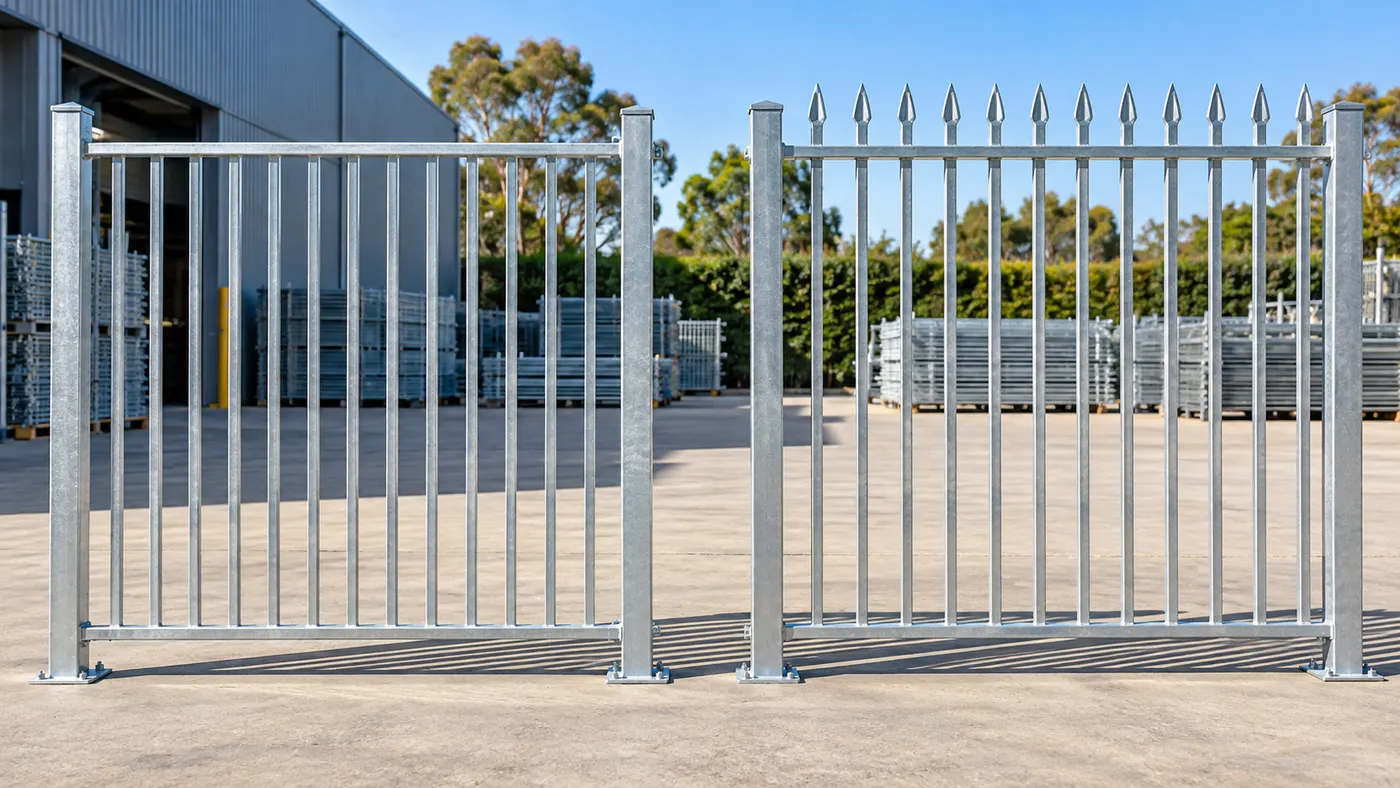 Security Panels
Flat Top vs Spear Top Security Fencing Panels: Which Should You Choose?
2 Nov 2026
Compare Flat Top vs Spear Security Fencing Panels for security, appearance, access control, site use, maintenance, and project needs.
Tell us about the fence.
One business day. That's how fast we come back with pricing once we have your quantity, finish and postcode.
Buying regularly? Apply for a credit account