
When Should Commercial Sites Order Custom Security Gates?
Learn when custom security gates for commercial sites make sense for unusual openings, heavy traffic, access control and perimeter security.
Introduction
When a Standard Gate Is Not the Best Fit
A commercial security gate has to do more than close an opening in a fence. It may need to manage staff, contractors, delivery vehicles, heavy equipment and visitors while maintaining the integrity of the site's perimeter throughout daily operations.
For many projects, a standard gate size can provide a practical solution. However, commercial and industrial properties are rarely identical. Existing fence lines, unusual opening widths, sloping ground, vehicle movements, security requirements and future expansion plans can create specifications that an off-the-shelf gate does not adequately address.
That is where Custom Security Gates for Commercial Sites become particularly useful.
Supaguard manufactures stock and custom chainwire gates for commercial and industrial applications, with custom fabrication available for gates, panels, posts and tubular framework. Its custom fabrication capabilities include single and double-leaf gates, sliding gates, swing gates and made-to-specification runs.Supaguard Fencing
Ordering custom does not mean every commercial project requires the most complicated gate possible. The objective is to identify when the site's dimensions, traffic patterns, security objectives or structural requirements justify a gate designed specifically for the application.
TLDR Quick Guide
When Custom Fabrication Makes Sense
Consider a custom security gate when a standard size does not properly match the required opening.
Existing commercial sites can have unusual fence heights, posts, boundaries or access points that require made-to-measure fabrication.
High vehicle traffic may affect the appropriate gate style, dimensions and supporting hardware.
Wide access points may require double-leaf or sliding configurations rather than a conventional single gate.
Pedestrian and vehicle access should be planned separately where site operations require different movement patterns.
Higher-security sites may require additional perimeter-security features.
A gate should integrate with the surrounding fence instead of creating a weak or awkward access point.
What Are Custom Security Gates for Commercial Sites?
Gates Fabricated Around Specific Project Requirements
A custom security gate is fabricated according to project-specific dimensions or specifications rather than selected exclusively from predetermined stock sizes.
This distinction can be important on commercial sites.
A warehouse entrance may need to accommodate delivery vehicles. An industrial yard may require a much wider opening for machinery. A school or sporting facility might require controlled pedestrian access alongside larger maintenance access. Infrastructure and utility facilities can have their own perimeter and security specifications.
Supaguard's custom fabrication capability includes custom-size chainwire gates in single and double-leaf configurations as well as sliding and swing gates. The company also fabricates posts, tubular framework and other fencing components from its own materials, with projects drafted by its in-house CAD team before fabrication.Supaguard Fencing
Customisation therefore allows the gate to begin with the site's actual requirements rather than forcing the site around a convenient stock dimension.
When Is a Standard Commercial Gate Usually Enough?
Standard Sizes Can Be Efficient for Straightforward Openings
Custom fabrication is not automatically necessary simply because a property is commercial.
Supaguard maintains a substantial range of standard chainwire gates in different heights, opening widths, finishes, hinge configurations and bolt options.Supaguard Fencing
If the opening matches an available gate, the traffic pattern is straightforward and the standard specification satisfies the site's security needs, a stock gate can be a practical choice.
For example, a straightforward pedestrian entrance or conventional vehicle opening may not require a unique fabricated design.
The important question is whether the stock configuration fits the application properly—not whether custom fabrication sounds more substantial.
Start With the Opening and Application
Before deciding between stock and custom, establish:
- Required clear opening.
- Fence height.
- Gate location.
- Pedestrian or vehicle use.
- Typical vehicle dimensions.
- Frequency of operation.
- Available swing or sliding space.
- Existing posts and fence construction.
- Desired security level.
- Ground and site conditions.
- Required finish.
- Locking and access arrangements.
- Potential future use.
Once these requirements are known, it becomes much easier to determine whether a standard product works or whether custom fabrication provides a better solution.
When Does an Unusual Opening Require a Custom Gate?
Non-Standard Widths Are a Common Reason to Order Custom
Existing commercial properties are not always built around today's standard gate dimensions.
A replacement gate might need to fit between established posts, structures or boundaries that cannot conveniently be relocated. New developments can also have openings determined by traffic engineering, equipment dimensions, property constraints or architectural plans.
In these circumstances, choosing the closest standard gate can create unnecessary compromises.
A gate that is too narrow can restrict access. A poorly matched gate can also complicate installation or require changes elsewhere in the fence line.
Custom fabrication allows the gate dimensions to be determined by the actual opening.
Measure the Clear Opening Carefully
Commercial buyers should distinguish between the required opening and the physical dimensions of the fabricated gate.
Supaguard specifically notes on its gate range that the listed gate width refers to the opening size, while the actual frame width is reduced to account for the gate installation.Supaguard Fencing
That detail demonstrates why accurate measurements matter.
A small misunderstanding at the ordering stage can become a significant issue once a fabricated gate arrives on site.
For projects where gate sizing is uncertain, Supaguard'scommercial chainwire gate sizing guide can help buyers think through opening width and site requirements before placing an order.
When Does Vehicle Traffic Justify a Custom Security Gate?
High-Traffic Entrances Have Different Demands
A gate serving an occasional maintenance vehicle has different operating requirements from one at a busy logistics facility.
Warehouses, distribution centres, manufacturing facilities and industrial yards may have vehicles entering and leaving throughout the working day. Gate selection therefore affects more than perimeter security; it can influence how efficiently traffic moves through the site.
Supaguard identifies traffic volume as an important factor when choosing industrial security gates for high-traffic facilities. Gate design also needs to consider durability, security, access requirements and compatibility with the surrounding fencing system.Supaguard Fencing
A custom gate becomes worth considering when standard dimensions or configurations interfere with the movement patterns the facility needs to support.
Design Around the Vehicles That Actually Use the Site
Do not size a commercial gate only around the smallest vehicle that currently passes through it.
Consider regular and occasional users, including:
- Passenger vehicles.
- Vans.
- Delivery trucks.
- Service vehicles.
- Forklifts.
- Trailers.
- Construction equipment.
- Emergency access requirements where applicable.
Vehicle turning movements and approach angles can also influence how much usable width is required.
A gate that technically accommodates a vehicle when approached perfectly straight may be less practical when that vehicle must turn through the entrance during normal operations.
When Should a Commercial Site Consider a Double Gate?
Wider Openings Often Need a Different Configuration
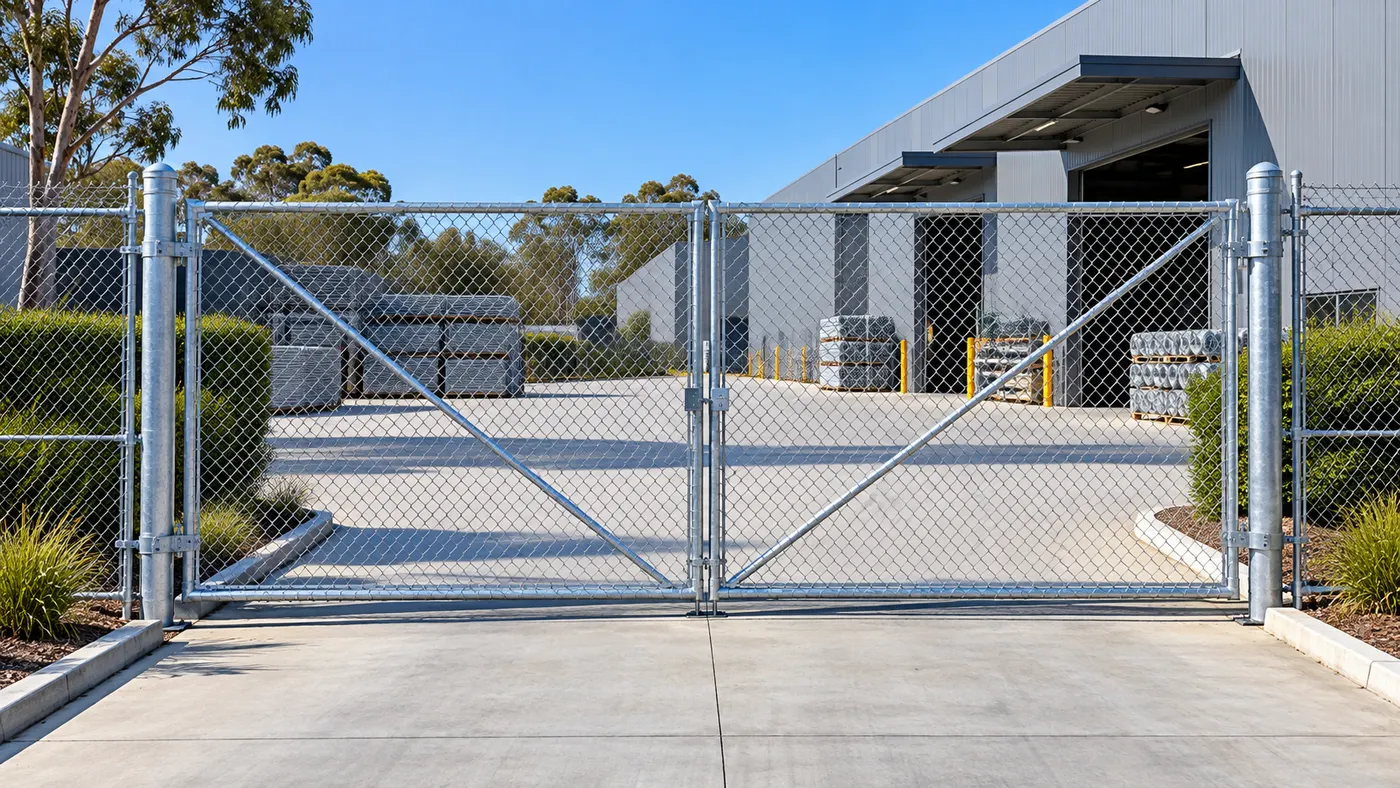
Double-leaf chainwire gates can provide a practical solution where commercial sites require broader vehicle access.
Instead of one large leaf spanning the complete opening, the entrance is divided between two leaves.
Supaguard offers both single and double chainwire gates, including standard and custom configurations. Its existing commercial guidance emphasises that the correct choice depends on access requirements, security and long-term functionality.Supaguard Fencing
Double gates may be appropriate for:
- Industrial yards.
- Warehouse entrances.
- Equipment access.
- Maintenance compounds.
- Commercial delivery areas.
- Construction-related sites.
- Wide service entrances.
- Think About How Often the Full Opening Is Needed
- Not every wide opening needs to remain completely open throughout the day.
- A site may need its full width only when large vehicles or equipment arrive.
Understanding actual traffic patterns can therefore help determine an appropriate configuration.
The aim should be to provide sufficient access without compromising normal site security or creating unnecessary operational effort.
When Should a Commercial Site Consider a Sliding Gate?
Limited Swing Space Can Change the Design
Swing gates require clear space through their operating arc.
That space may be difficult to provide at a busy commercial site where vehicles queue near the entrance, buildings sit close to the fence line or internal circulation space is limited.
A sliding gate moves differently and may therefore suit certain constrained openings.
Supaguard identifies sliding gates among the systems it can fabricate to specification.Supaguard Fencing
However, the decision should be based on site geometry and the complete gate design rather than assuming sliding is automatically superior.
Consider the Entire Movement Area
When evaluating a sliding configuration, account for where the gate leaf will travel when opened.
The surrounding structure, posts, track or supporting arrangement, fence line and available run-back space all need consideration.
The ground and site layout also matter.
Custom fabrication is particularly valuable in these situations because dimensions and framework can be developed around the actual entrance rather than selecting a gate without considering how it will physically operate.
When Do Higher Security Requirements Call for Customisation?
The Gate Should Not Become the Weak Point
A secure commercial perimeter is only effective when its access points support the same security objective.
Supaguard notes that commercial gates regulate movement of employees, visitors, contractors and vehicles while maintaining perimeter integrity. Higher-security facilities may also require enhanced locking arrangements or integration with access-control measures.Supaguard Fencing
This means gate selection should be considered as part of the overall perimeter.
A tall security fence paired with an unsuitable gate can undermine the consistency of the boundary.
Some Sites Require Additional Deterrence
Industrial, infrastructure, government and restricted-access facilities can require greater resistance to unauthorised entry.
Depending on project requirements and applicable regulations, this may involve a gate configuration that complements security features elsewhere in the fence line.
Supaguard manufactures chainwire gates with 3-barb configurations for applications where additional perimeter protection is required. These use angled extensions and barbed wire to increase climbing difficulty and strengthen the deterrent effect of the access point.Supaguard Fencing
Any enhanced security configuration should be selected according to the site's risk profile, application and applicable safety or regulatory requirements rather than added indiscriminately.
Why Should a Custom Gate Match the Existing Fence?
Perimeter Continuity Matters
The gate and fence should function as one system.
Differences in height, mesh, frame strength or security features can create an inconsistent perimeter and make the entrance visually or structurally disconnected from the surrounding fencing.
For commercial projects, consider whether the gate needs to match:
- Fence height.
- Mesh specification.
- Finish.
- Security topping.
- Post arrangement.
- General perimeter design.
Supaguard's security-fencing guidance recommends that gate materials, mesh specifications and overall design complement the surrounding fencing system.Supaguard Fencing
This is another situation where custom fabrication can be useful, particularly when adding a gate to an established perimeter.
Existing Sites Can Present More Constraints Than New Builds
On a new project, designers may have greater flexibility to coordinate the entire fence and gate system from the beginning.
Existing sites can be more complicated.
Posts may already be installed. Fence heights may be non-standard. Buildings, kerbs, services and traffic routes may limit where a new access point can be positioned.
Custom fabrication can help adapt the gate to these fixed conditions instead of requiring extensive modifications simply to accommodate a standard product.
How Do Gate Height and Width Affect the Design?
Bigger Gates Create Different Structural Demands
Increasing gate dimensions changes more than the amount of mesh required.
A larger gate frame places additional demands on:
- Hinges.
- Gate posts.
- Connections.
- Supporting hardware.
- Latches and bolts.
- Overall frame rigidity.
Supaguard's technical guidance on chainwire gate hinges explains that larger and heavier gates create greater loads on hinges, posts and structural connections. Incorrectly specified components can contribute to sagging, difficult operation, increased wear and structural strain.Supaguard Fencing
This is why a custom commercial gate should be designed as an assembly rather than merely specifying a width and height.
Hardware Must Suit the Gate
A gate can only perform as well as the components supporting it.
Commercial projects should consider the relationship between frame size, weight, hinges, posts and other hardware.
Supaguard supplies fabrication components including base plates, flanges, bolts, chains, brackets, latches and related gate hardware.Supaguard Fencing
Correct component selection helps the gate remain aligned and functional under the demands of regular site use.
What Role Do Pipes and Posts Play in Custom Gates?
The Framework Carries the Gate
Gate design does not stop at the mesh.
Pipe framework provides structural support, while posts transfer loads into the supporting installation.
This becomes increasingly important as gate size, weight and usage increase.
A heavily used commercial vehicle gate may place substantially different demands on its supporting structure than a small pedestrian gate.
For custom projects, posts and framework should therefore be considered at the same time as the gate itself.
Do Not Treat the Supporting Structure as an Afterthought
A strong gate attached to inadequately specified posts does not create a strong gate system.
The supporting components need to be appropriate for the gate's dimensions, configuration and application.
Supaguard's custom fabrication service includes fabricated pipe posts and tubular framework alongside made-to-measure gates.Supaguard Fencing
Coordinating these components can reduce the risk of ordering a gate that does not suit the structure intended to support it.
How Important Are Gate Fittings?
Small Components Have a Major Job
Hinges, bolts, latches, chains and other fittings may represent a small portion of the physical gate, but they directly influence operation and security.
A commercial gate can be opened and closed hundreds or thousands of times over its working life.
Poorly matched hardware can contribute to:
- Difficult opening.
- Misalignment.
- Premature wear.
- Sagging.
- Unreliable closure.
- Increased maintenance.
That makes fittings part of the original specification rather than accessories to think about after fabrication.
Match Fittings to the Application
Pedestrian and large vehicle gates do not impose identical loads.
Likewise, a lightly used storage compound and a busy distribution centre have different operational patterns.
The appropriate hardware should reflect those differences.
Supaguard'sgate range includes different gate dimensions, finishes, hinge arrangements and bolt configurations, while custom fabrication allows non-standard projects to be developed around their particular requirements.
When Should Access Control Be Planned?
Plan Before the Gate Is Fabricated
If a commercial site expects to use controlled entry, access requirements should be considered during the design stage.
Depending on the facility, controlled access may involve procedures or systems for employees, contractors, visitors and vehicles.
Waiting until after fabrication can complicate the project if the gate, posts or hardware were not specified with the intended arrangement in mind.
The physical gate and the site's access procedures should therefore be considered together.
Think Beyond Today's Requirements
A site may begin with relatively simple access arrangements and change later.
Tenant requirements can evolve. Traffic can increase. New operational areas can open. Security policies can become more stringent.
Future growth is one of the considerations Supaguard identifies when selecting commercial chainwire gates.Supaguard Fencing
Planning for reasonable future requirements can reduce the likelihood that a newly installed gate quickly becomes inadequate.
When Should a Site Order a Custom Pedestrian Gate?
People and Vehicles Have Different Access Needs
Commercial gate planning often focuses heavily on vehicles.
Pedestrian movement deserves equal consideration.
Employees and visitors repeatedly using a large vehicle entrance can create operational conflicts depending on the site layout and traffic patterns.
A dedicated pedestrian gate can provide a more appropriately sized access point where the site's design and security procedures support one.
Custom fabrication may be useful when that pedestrian entrance needs to match an existing fence height, unusual opening or particular site specification.
Separate Access Can Improve Site Organisation
Separating pedestrian and vehicle movements can make an entrance easier to manage.
However, the appropriate arrangement depends on the site.
Consider:
- Employee movement.
- Visitor entry.
- Vehicle frequency.
- Delivery routes.
- Internal paths.
- Security procedures.
- Accessibility requirements.
- Applicable building and safety requirements.
Gate design should support the site's broader movement plan rather than being considered in isolation.
Should Future Expansion Affect Gate Specifications?
Design for Realistic Operational Change
A gate that works perfectly today may become restrictive if the site's operations expand.
For example, a facility may later:
- Receive larger vehicles.
- Increase delivery frequency.
- Add another tenant.
- Change traffic flow.
- Introduce new equipment.
- Expand a storage or production area.
- Modify security procedures.
- Not every project needs oversized infrastructure for hypothetical future scenarios.
- However, known or reasonably planned changes should be included in gate selection.
- Avoid Designing Only for the Minimum Requirement
- Ordering the smallest possible gate may reduce flexibility.
Conversely, unnecessarily large gates can add cost and structural requirements without providing useful operational value.
The better approach is to establish realistic present and future access requirements before fabrication.
Customisation then becomes a tool for achieving the correct specification rather than simply making the gate larger.
When Should You Order a Custom Gate During a Commercial Project?
Earlier Planning Reduces Last-Minute Compromises
Custom fabrication requires accurate information.
The project team should establish gate requirements once the relevant opening dimensions, fencing specifications and access needs are sufficiently defined.
Leaving gate selection until the surrounding fence is already being installed can create unnecessary complications if the required opening turns out to be non-standard.
Early coordination is especially valuable when custom posts, framework, security features or specialised configurations are involved.
Finalise the Specification Before Fabrication
Before placing a custom order, confirm important details such as:
- Quantity.
- Opening width.
- Height.
- Gate configuration.
- Fence specification.
- Finish.
- Hinge requirements.
- Posts and framework.
- Hardware.
- Site conditions.
- Security requirements.
- Intended traffic.
Supaguard's in-house custom process is designed around project specifications, with custom work drafted and confirmed before fabrication. The company states that custom gates, panels and posts can be manufactured to exact measurements and drawings.Supaguard Fencing
What Should Commercial Buyers Provide When Requesting a Custom Gate?
Better Information Leads to a Better Specification
A vague request for "a large security gate" is rarely enough.
Commercial buyers should provide as much relevant project information as possible.
Start with accurate dimensions and explain how the gate will be used.
Include the type of site, expected traffic, surrounding fencing, preferred finish and any special security considerations.
Photos, plans or drawings may also help clarify unusual site conditions.
Ask Questions Before the Gate Is Manufactured
Clarify uncertainties before approving fabrication.
If you are unsure whether you need a single, double or sliding gate, explain the opening and traffic pattern instead of selecting a configuration arbitrarily.
Likewise, ask about compatible posts, hinges and fittings if they form part of the project.
Supaguard states that buyers can provide job details, dimensions, application and site conditions so its team can help identify an appropriate combination of fencing components.Supaguard Fencing
When Is Custom Fabrication Worth the Investment?
Look at Operational Fit, Not Customisation for Its Own Sake
The value of a custom gate comes from solving a real project requirement.
Custom fabrication is particularly worth considering when:
- The opening is non-standard.
- Vehicle access requires unusual dimensions.
- Swing clearance is restricted.
- A sliding configuration better suits the site.
- The existing fence needs to be matched.
- Higher-security specifications are required.
- Standard gate heights are unsuitable.
- Special posts or framework are necessary.
- The entrance experiences demanding commercial traffic.
- Planned expansion changes access requirements.
If none of these conditions applies and a stock gate satisfies the project, custom fabrication may not be necessary.
Consider Whole-of-System Performance
Purchase price should not be the only factor.
A gate that does not suit its opening or daily traffic can create operational difficulties and potentially require modification or replacement.
Correctly specifying the gate from the beginning can support smoother access, consistent perimeter security and more reliable long-term operation.
For businesses deciding which configuration fits a demanding facility, Supaguard's guide to choosingindustrial security gates provides additional considerations around durability, access and high-traffic applications.
Key Takeaways
What to Remember Before Ordering
Custom Security Gates for Commercial Sites are most useful when standard products do not adequately meet the project's dimensions, traffic or security requirements.
Custom fabrication should solve a specific site problem rather than being selected automatically.
Unusual opening widths are a common reason to specify a custom gate.
Existing commercial sites may have fixed posts, boundaries and structures that require made-to-measure fabrication.
Vehicle type and traffic frequency should influence gate design.
Wide entrances may benefit from double-leaf or sliding configurations.
Swing clearance should be assessed before choosing a swing gate.
Gate height and security features should complement the surrounding perimeter.
Higher-security sites may require enhanced deterrence and access-control considerations.
Frequently Asked Questions
When should a commercial property order a custom security gate?
A commercial property should consider a custom security gate when standard dimensions or configurations do not adequately suit the opening, traffic requirements, surrounding fence or security objectives. Custom fabrication can also be useful for wide vehicle entrances, unusual fence heights, constrained operating spaces or sites requiring specialised framework. The final specification should be based on measured site conditions and operational requirements rather than choosing custom fabrication simply because it is available.
What information is needed to order a custom commercial security gate?
Start with the required opening width, gate height, site application, expected traffic, surrounding fencing and preferred configuration. Buyers should also identify relevant finish, security, post, hardware and access requirements before fabrication begins. Providing accurate drawings, measurements and site information helps the fabricator develop a gate suited to the project.
Are custom security gates only for high-security facilities?
No, custom gates can be useful whenever a commercial site's dimensions or operating requirements are not adequately served by a standard gate. Warehouses, schools, sporting facilities, logistics centres, industrial yards and other commercial properties may require non-standard access points without necessarily being classified as high-security sites. The need for customisation depends on the application, opening and operating requirements.
Should a commercial site choose a swing gate or sliding gate?
The appropriate choice depends on available space, opening width, traffic patterns, site geometry and the intended operating arrangement. Swing gates require suitable clearance for the leaves, while sliding gates require adequate space and supporting infrastructure along their travel path. A site-specific assessment can help determine which configuration better suits the entrance.
Can a custom gate match an existing chainwire fence?
Custom fabrication can be useful when a new gate needs to coordinate with an existing fence's dimensions, mesh, height, finish or overall security profile. Matching the access point to the surrounding perimeter helps maintain a more consistent fencing system. Exact compatibility should be confirmed from the existing fence specifications and site measurements before the gate is fabricated.
Products and a project to match.
Chainwire Gates
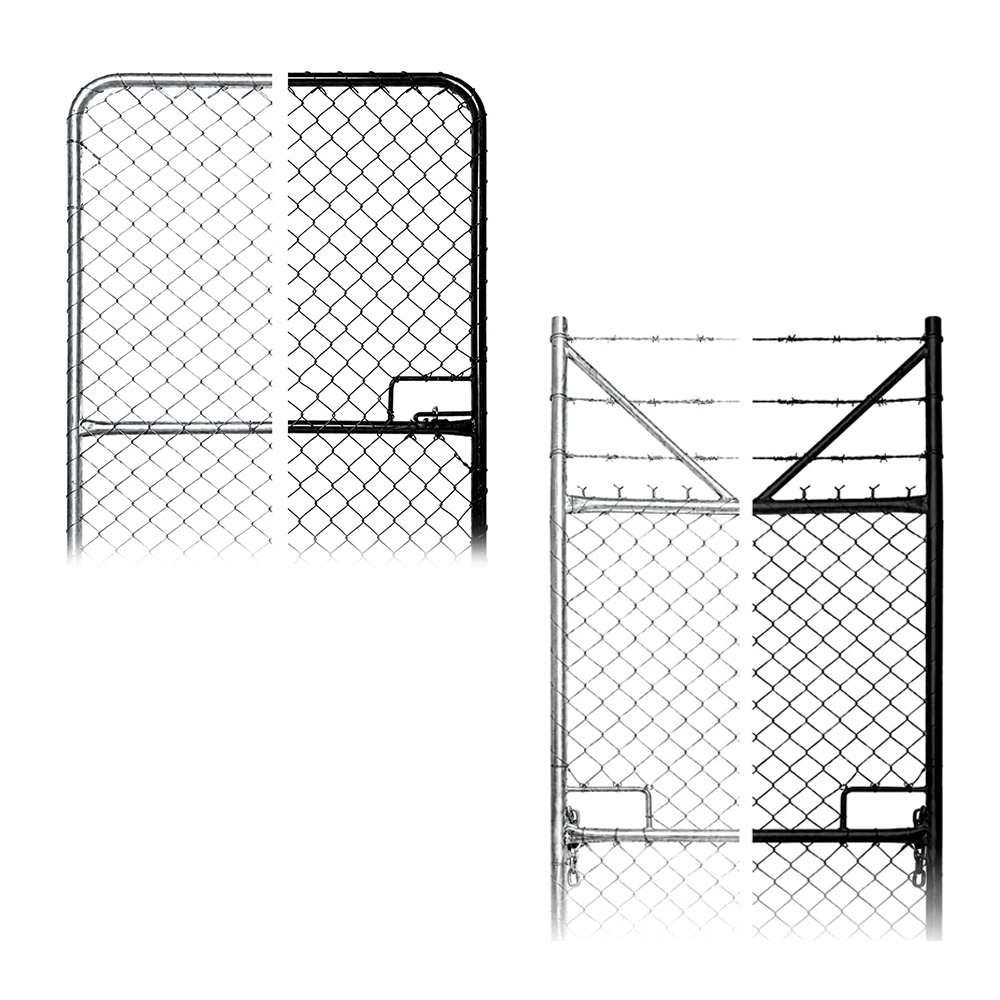
Single and double chainwire gates, with or without 3 barb, in galvanised or black. In stock or custom fabricated in house. Supplied from NSW and QLD.
 Industrial
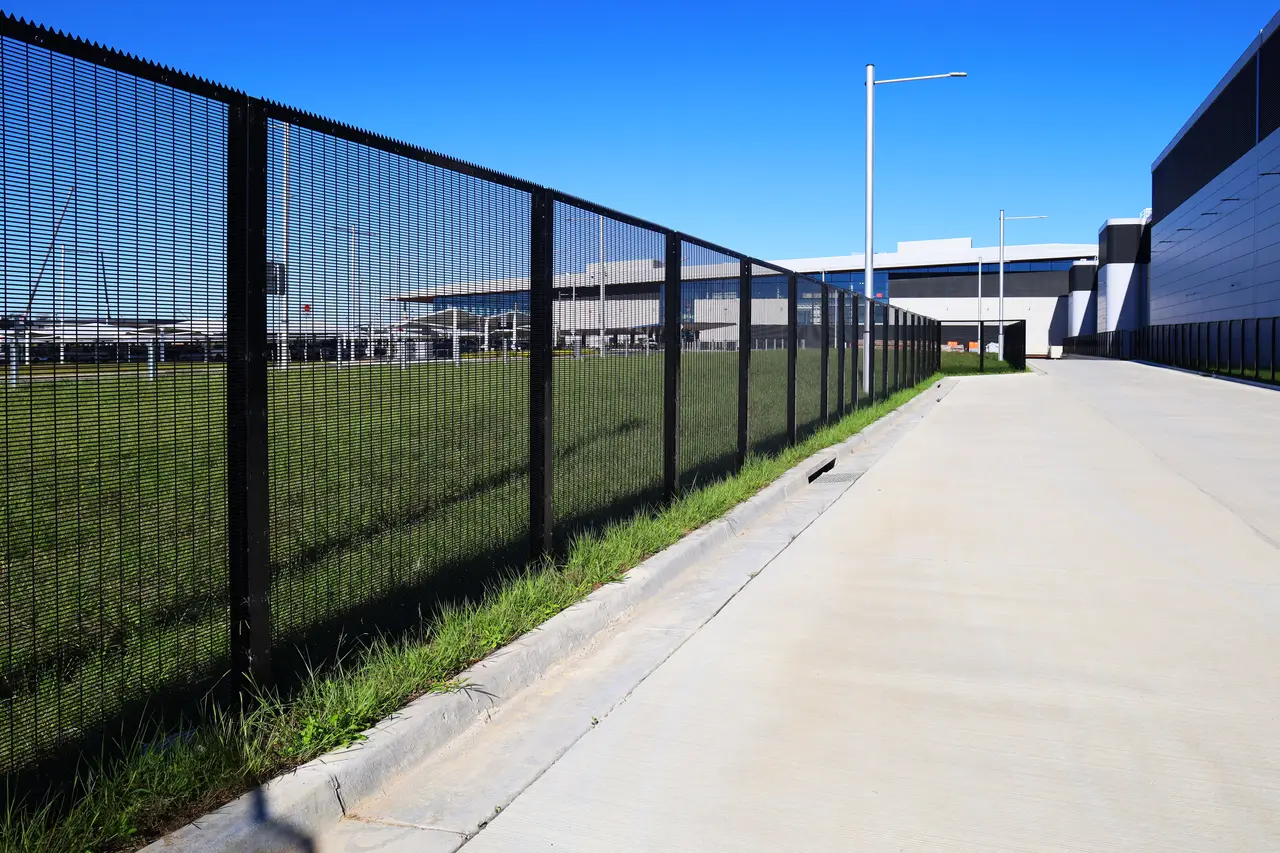
Anti-climb boundary and sliding gates for a logistics yard
Australia
Warehouse and container yard boundaries built from anti-climb mesh and spear-top steel, with razor topping on the exposed runs and sliding gates on the vehicle entries.
More from the blog.
 Custom Mesh Manufacturing
When Should You Order Custom Chainwire Mesh Sizes?
2 Nov 2026
Learn when custom chainwire mesh sizes make sense for security, sports, industrial and non-standard fencing projects.
 Chainwire Gates
What Size Chainwire Gate Do You Need for a Commercial Site?
3 Oct 2026
Learn how to choose a chainwire gate size for a commercial site based on vehicles, access needs, opening width, height and security.
 Gates
Key Features of Commercial Chainwire Gates Explained
3 June 2026
Learn the key features of commercial chainwire gates and how they improve security, access control, and perimeter protection.
Tell us about the fence.
One business day. That's how fast we come back with pricing once we have your quantity, finish and postcode.
Buying regularly? Apply for a credit account